
Workplace Mental Health Strategies That Actually Work: Insights from Aino and Mindler
Mar 12
Mental health challenges have become one of the greatest work‑life issues of our time. We read about them in the media almost daily, we encounter them in our organizations, and many of us have personal experiences of how declining mental well‑being affects both everyday life and work ability. The WHO estimates that mental ill‑health will be the leading cause of disease globally by 2030, and in Sweden, it accounts for more than half of all long‑term sick leaves. At the same time, nearly half of people struggling with mental health issues say stigma makes it difficult to talk about their problems with others.
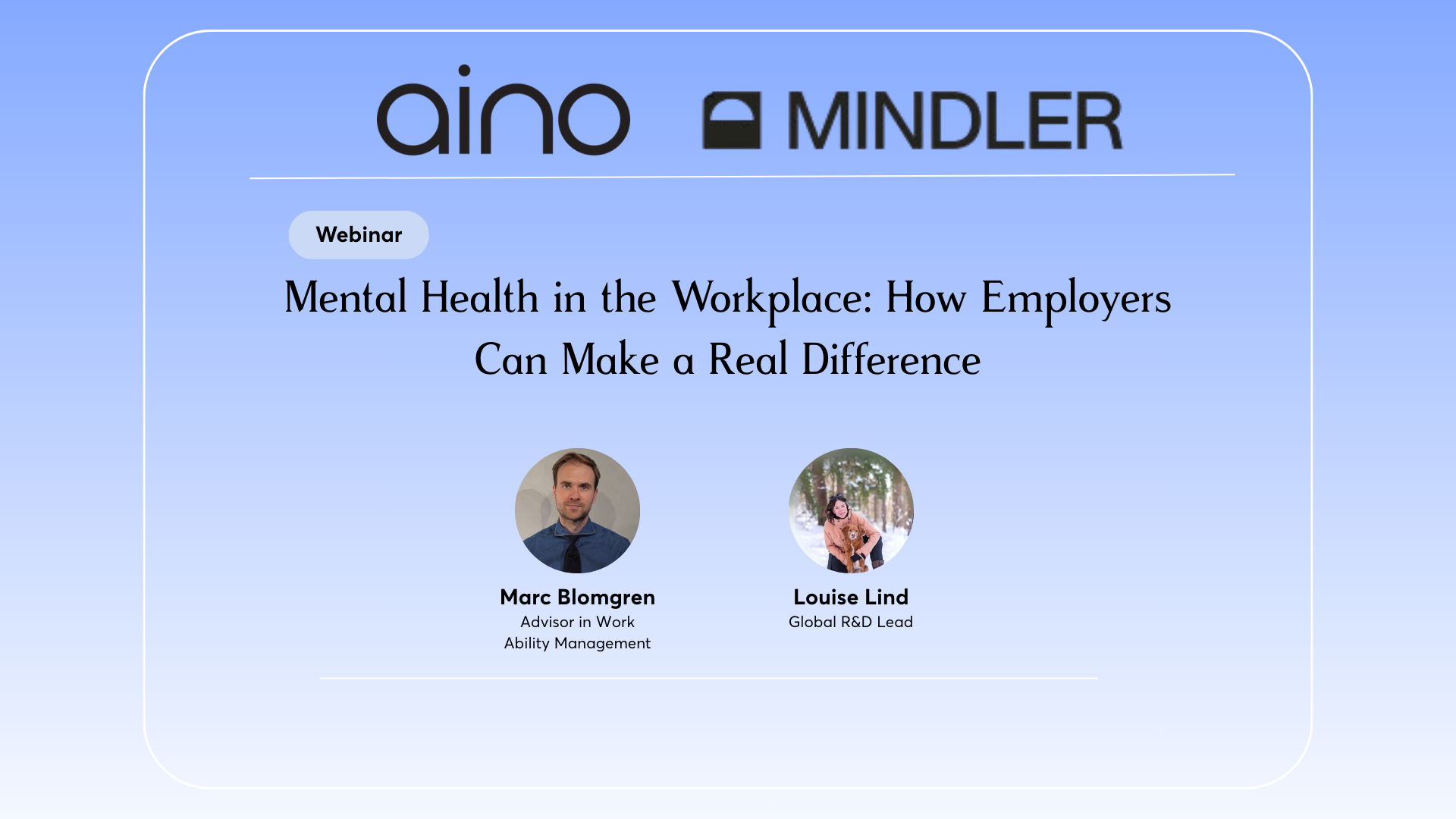
During our recent webinar with psychologist Louise Lind from Mindler and myself (Marc Blomgren) from Aino, we gained deeper insights into how today’s working life is affected and how employers can make a concrete difference. One of the most important messages was that mental health isn’t a black‑and‑white issue. We are not either "ill" or "healthy." We all move along a continuum where well‑being and psychological challenges coexist and change over time. This insight is crucial because it helps us recognize early signs before issues grow large.
Young Adults – A Generation Carrying More Than Previous Ones?
In the webinar, we focused particularly on young adults, the group that stands out the most in both Swedish and international statistics. Louise shared that 80% of young patients at Mindler report reduced work ability due to mental health issues, compared with 70% among those over age 56. Data from the National Board of Health and Welfare shows that the proportion of children and young people receiving care for mental health problems has doubled since 2010, and demand continues to grow faster than healthcare’s capacity to meet it.
What’s behind this development?
Louise described a “perfect storm” of factors affecting today’s youth:
Digital environments and constant comparison with others
Performance pressure, both external and internal
Sleep problems linked to screen use, stress, and irregular routines
Decreased in‑person social interaction and more sedentary behavior
Climate anxiety, worry, and fast‑paced news cycles that trigger stress
Many of today’s young adults therefore enter working life with increased vulnerability, meaning employers need both the knowledge and the systems to catch early signals in time.
How Employers Can Work – Three Levels That Build Sustainability
A large part of the webinar focused on how employers can build an environment where ill‑health is detected early and where employees receive the right support. Louise divided this into three levels: promote, prevent, and act.
1. Promote Health – The Foundation for Everything
One of the strongest messages was that having work itself is one of the most health‑promoting factors we have. It brings structure, relationships, skills development, meaning, and identity, all essential for psychological well‑being.
For a workplace to be health‑promoting, it needs:
Meaningfulness: linking tasks to a bigger purpose
Structure and clarity: clear roles, mandates, and expectations
Relationships and belonging: space for connection, dialogue, and team spirit
Trust and psychological safety: a climate where people can talk openly about mistakes, challenges, and well‑being
These factors not only create well‑being but also build engaged, effective, and sustainable teams.
2. Prevent Ill‑Health – See Imbalance Before It Becomes Acute
Ill‑health rarely appears overnight. It grows gradually from an imbalance between demands and resources. To prevent this, employers need to:
Regularly follow up on workload
Ensure that resources are in place
Give managers time, tools, and mandate to have early conversations
Understand when an employee is moving in the wrong direction on the continuum
Early detection is crucial but difficult without structure.
3. Act Early – The Key Factor for Breaking Negative Cycles
When early signs appear, managers must know exactly what, when, and how to act. Louise highlighted several essential principles:
Act immediately when changes in behavior or increased absence are noticed
Validate the employee – understanding their story is key to a good conversation
Focus on work ability, not diagnoses or private details
Adjust work proportionately – don’t remove all demands; demands are part of recovery
Make adjustments together, not for the employee
Always follow up, with clear timelines for every agreement
What creates safety in a workplace isn’t perfect answers but clear processes.
How Aino Helps Organizations – Turning Good Intentions into Real Results
Many employers want to work proactively with mental health but lack the structure, time, or data to do so effectively. This is where Aino’s platform makes the biggest difference.
1. Clear and Reliable Processes – for Both Managers and Employees
Aino’s platform gives managers a clear structure from the first signal to full return‑to‑work. This means:
No early signs are forgotten
Managers receive support before, during, and after each conversation
Every step is documented safely and with high quality
Both manager and employee know what is expected
2. Early Detection of Reduced Work Ability
The system analyzes data on absence, recurring patterns, and behavioral changes and provides early alerts when:
Short‑term sick leave increases
An employee shows recurring signs of ill‑health
Early dialogues have taken place but issues remain
This allows organizations to intervene before problems become severe enough to require sick leave.
3. Insights into the Root Causes of Absence
Aino also makes it possible to work strategically with the underlying causes of absence. By compiling and analyzing data over time, organizations can clearly see where and why ill‑health occurs:
Is the workload too high in a specific department?
Are there patterns linked to leadership, work environment, or shift work?
Do problems arise particularly during organizational changes?
Are some parts of the organization better at catching early signs than others?
4. A Tool for Modern, Sustainable Leadership
Today’s working life places high demands on managers, but few receive enough support. Aino’s platform acts as a digital guide in every manager’s pocket, helping them:
Avoid missing early warning signs
Know exactly how to act
Hold conversations that are both empathetic and structured
Follow up in a way that supports the employee and protects the organization
What Mindler Offers Companies – and How It Connects to the Webinar
Mindler is a digital psychology service that helps companies quickly and easily give employees access to professional mental‑health support. They offer:
Video sessions with licensed psychologists
Internet‑based CBT (iCBT)
Mental Health First Aid (MHFA) training
Leadership development with coaching
Early interventions are crucial for preventing long‑term sick leave and creating sustainable workplaces. By combining quick access to psychological treatment, digital self‑help programs, first‑aid training, and leadership support, Mindler helps organizations detect signals early and act before problems escalate.
Clarity, Empathy, and Data‑Driven Support – The Path to Healthier Workplaces
The webinar made clear that mental ill‑health is complex, but the solutions are often highly concrete. It’s about:
Working proactively
Seeing early signals
Acting early
Following up
Providing the right conditions for both managers and employees
Aino’s system support makes this possible in reality. With clear processes and data‑driven insights, organizations can reduce absence and build a work culture where people feel better, perform better, and stay longer.
If you want to learn more about how Aino and Mindler can help your organization build a more sustainable and health‑promoting workplace, feel free to contact me.